The Acropolis - Part One - Reaching The Parthenon
- Ben Parker
- Jun 29
- 4 min read

Updated: 6 days ago

There are few landscapes as instantly recognisable as the city of Athens. Its iconic structures perch upon ancient rock formations, staring out over the modern day city.
On the second day of our trip, we ventured away from our hotel along the Marathon coast and into the city. There was an accessible bus route from Nea Makri into Athens, but we decided instead to save hassle and spent 50 Euros each way on a taxi. Our incredible taxi driver Lucas pointed out all of the sites as we got closer, such as the Panathenaic Stadium, which I wasn't fast enough to get a photograph of.
One of the things about this trip that made it so special to me is that for a while I didn't think I would ever have the chance to go. Greek mythology and history have been my greatest passion for so long, yet holidays and travelling haven't always been the easiest thing for me. I had essentially booked the exact same holiday four years prior, and cancelled it, losing out on the money paid, and the experience. But now, I don't regret doing so. That was what was needed at the time and led me onto a pathway of discovery, gaining an autism diagnosis and a greater understanding of myself.
So as we pulled up as far as Lucas could take us, by the slopes of the Acropolis, and I looked up, it was such a powerful and emotional moment. There was no mistaking it, I had finally made it to Athens. Everywhere that I looked was a site that felt so familiar, known the world over. Yet you can't replicate that feeling of standing on the slopes, surrounded by olive trees, staring up at the Acropolis.
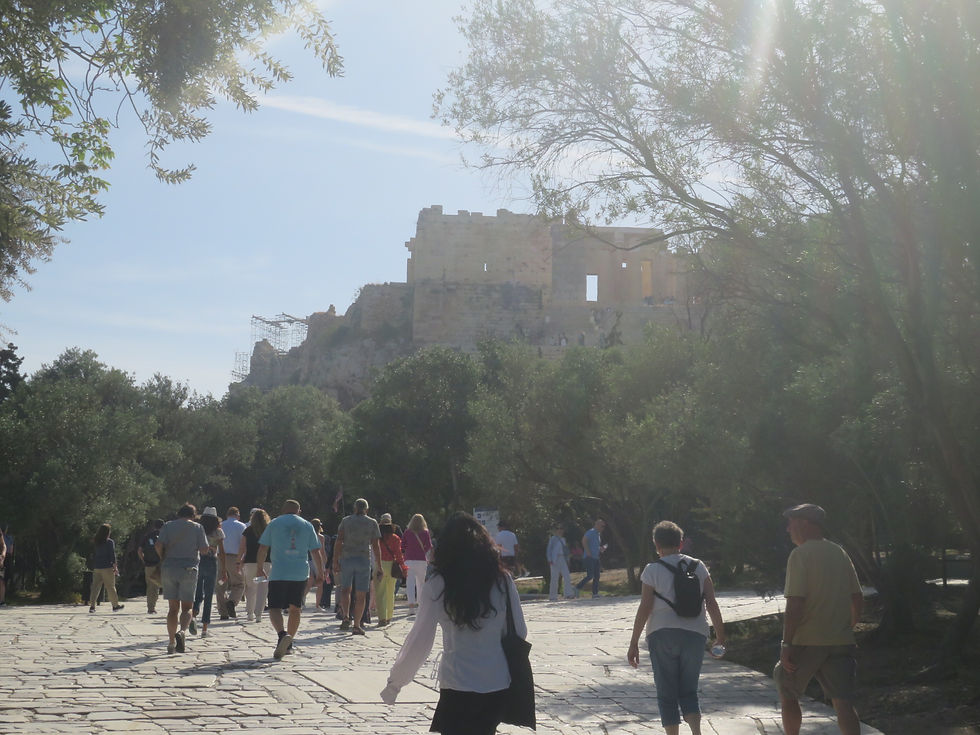

Thanks to our decision to ditch the bus and take a taxi, we arrived early for our slot, and had plenty of time to visit another site of historical significance, that just so happens to offer the most incredible views of the Acropolis and the city of Athens: Areopagus Hill. Named after the Greek god of war, Ares, this hill was not only a great spot to view the sites, but served an important role in Athenian democracy, being the gathering place for the highest judicial council.
But as I climbed up the modern metal steps, onto the great rock, the first thing that struck me was how a site of such significance didn't need to be dressed up in marble or gold. All the Athenians required was a place to discuss ideas, and this natural hill provided just that. The second thing that ran through my mind was how shiny and smooth the rockface was, worn down and polished from millions of footsteps, from ancient times to today.
The views of the Acropolis from Areopagus Hill in the early morning sun were breathtaking. But even more than that, were the incredible views of Athens. The modern city living in harmony with incredibly significant sites such as the Ancient and Roman agoras and Philopappou Hill, all visible from this vantage point.


After making our way back down Areopagus Hill, all without managing to slip or fall over, we began our ascent. I later learnt that the entrance we went in was not the only one, and missed out on walking past the Theatre of Dionysus.
As we journeyed up, past these incredible, detailed marble columns laying in the grass all around, we came to the incredible site of the theatre of the Roman senator Herodes Atticus. Due to staying in Marathon, and visiting the Sanctuary of the Egyptian Gods next to our hotel, built by the same man, I felt a greater intrigue toward him than I believe I would otherwise have.
The amphitheatre was built in memoriam to Herodes' late wife, and he spared no expense. In order to get a sense of the grandeur, decadence, and scale, you really need to see the site from both sides.


We kept moving up the slopes, I believe on the south slopes, past more olive trees than I could possibly count, with marble ruins scattered by their trunks. And before long the incredible architecture of the Acropolis structures came into focus. As I try to remember walking up the great steps, through the Propylaea, I'm not sure I blinked. For a moment, I'm going to allow the photographs to capture what my words cannot.


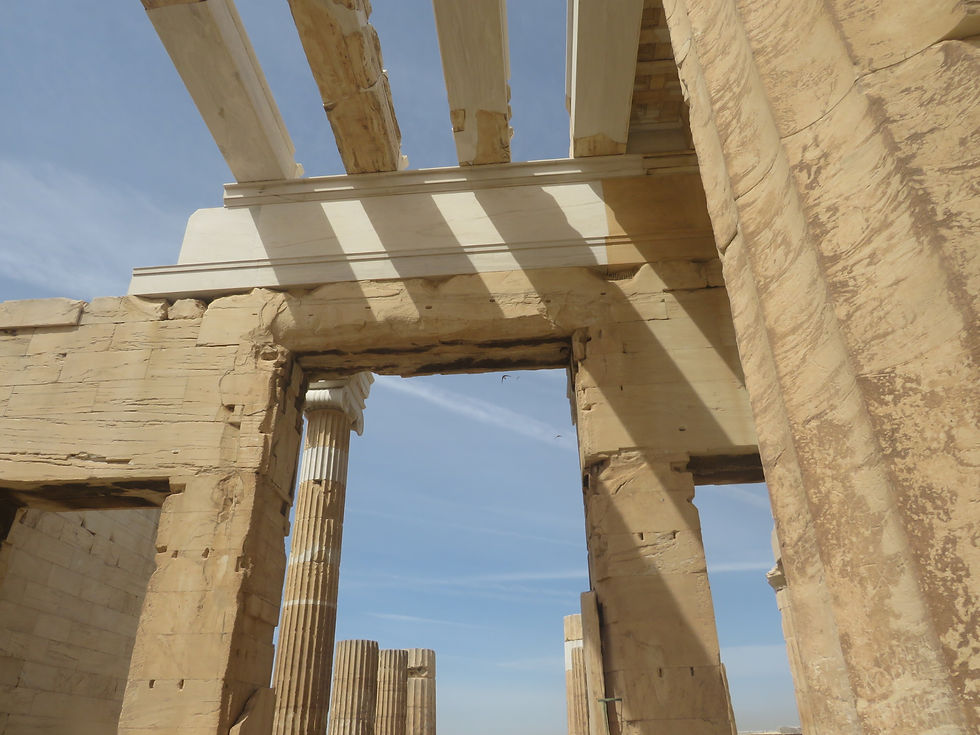


To admire these structures from across the world is one thing. To stare up at the Ionic columns, witnessing the detail with my own eyes, feeling the scale and weight of it, is an entirely different thing. And as I moved through, soaking in the details, I emerged, the view of Athens even grander now in the distance, and the Parthenon in clear view before me.
I didn't know it at the time, but during my visit, they were carrying out significant repair work to the front of the Parthenon, which has since been completed, making the temple of Athena the most complete it has been in over 200 years. If you zoom in closely you can see the colour difference on the marble pediment.


The Parthenon, deriving from the Greek word 'Parthenos', meaning 'virgin', is dedicated to the city's patron goddess, Athena. While the Acropolis has evidence of having been used as a fortified settlement as far back as the Neolithic period, the Parthenon was constructed between 447 and 438 BCE.
Under the orders of Pericles to celebrate the wider Athenian victory over the Persians in the Greco-Persian Wars, the construction of all the Acropolis's most iconic monuments began shortly after, as Pericles projected Athens' renewed power to the Mediterranean world. Just a few of the monuments ordered under Pericles' rule include the Parthenon, the Propylaea, the Temple of Athena Nike and the Odeon of Pericles.
In the next post I will continue my exploration on top of the Acropolis, exploring the iconic site of the Erechtheion, as well as following the mythological footsteps of Athens.


Comments